THaW on TV

Blog post from Professor Kevin Fu —

NBC Chicago interviews patients, physicians, and researchers on medical device security

The TV headline is hyperbolic, but the content is level headed.

Tammy Leitner of NBC Chicago interviewed a number of patients, physicians, and researchers about the challenges of medical device security. Here’s a link to the full video.

Had this interview happened in 2008, the tone would have likely been more confrontational. Remember when Archimedes researchers demonstrated radio-controlled security flaws in pacemaker/defibrillators (also see the Schneier commentary)? Back in 2008, manufacturers and FDA were not accustomed to interacting with security researchers reporting such software-based flaws. It’s completely understandable. Imagine if an unfamiliar person showed up at your front door to point out security problems of your house. The outcome might be unpleasant. Thus, interactions initially got off to a rocky start. But that’s the past.

Fast forward to 2014, and times have changed significantly for the better. The forward-thinking manufacturers, influential researchers, and health care providers regularly interact and help each other to improve medical device security. A few positive examples that brought researchers, clinicians, manufacturers, and regulators together include the draft technical information report on medical device cybersecurity by AAMI (the IETF equivalent of the medical manufacturing world), the Archimedes workshop, and the upcoming FDA workshop on medical device security.

So if you’re a future graduate student or budding security researcher, I’d encourage you to read the technical papers from the short history of medical device security. It’s no longer a cat-and-mouse game of pointing out buffer overflows and SQL injection attacks. The future is about interdisciplinary computing and health care research to produce technology, best practices, and policies that improve medical device security without interfering with the workflow or delivery of health care.

Link to original blog post here.

ZEBRA press

THaW’s article about Zero-Effort Bilateral Recurring Authentication (ZEBRA) triggered a lot of press coverage: such as Communications of the ACM (CACM)VICE Motherboard, Dartmouth NowGizmagThe Register UKPlanet Biometrics*, Computer Business Review*,  Fierce Health ITDaily Science NewsSenior Tech Insider, Motherboard, Homeland Security Newswire, and NFC World. They’re all intrigued by ZEBRA’s ability to continuously authenticate the user of a desktop terminal and to log them out if they leave or if someone else steps in to use the keyboard. Some(*) mistakenly believe our ZEBRA method uses biometrics; quite the contrary, ZEBRA is designed to be user-agnostic and thus requires no per-user training period. (ZEBRA correlates the bracelet wearer’s movements with the keyboard and mouse movements, not with a prior model of the wearer’s movements as do methods built on behavioral biometrics.)  ZEBRA could be combined with a biometric authentication of the wearer to the bracelet, and can be combined with other methods of initial authentication of wearer to system (such as username/password, or fingerprints) making it an extremely versatile tool that adds strength to existing approaches. The Dartmouth THaW team continues to refine ZEBRA. [Note: since the time this paper was published we have learned of a relevant trademark on the name “Zebra”. Thus, we have renamed our approach “BRACE” and will use that name in future publications.]

photo of Shimmer device on a wrist, wherein the hand is using a mouse and the other hand is using a keyboard

Our experiments used the Shimmer research device, though in principle it could work with any fitness band.

THaW annual meeting

Our team held its annual in-person meeting, this year on the edge of the Green on the beautiful campus of Dartmouth College. Two days of enriching technical talks about work in progress, brainstorming sessions about upcoming programs, and valued feedback from our NSF program officers… plus opportunities for our five-university group to build connections and collaborative bonds. A few hardy souls hiked to the top of nearby Mount Cardigan the morning after the meeting, in a stiff breeze that reminded us all Fall is approaching.

Group photo at the Dartmouth meeting, September 2014

Group photo at the Dartmouth meeting, September 2014

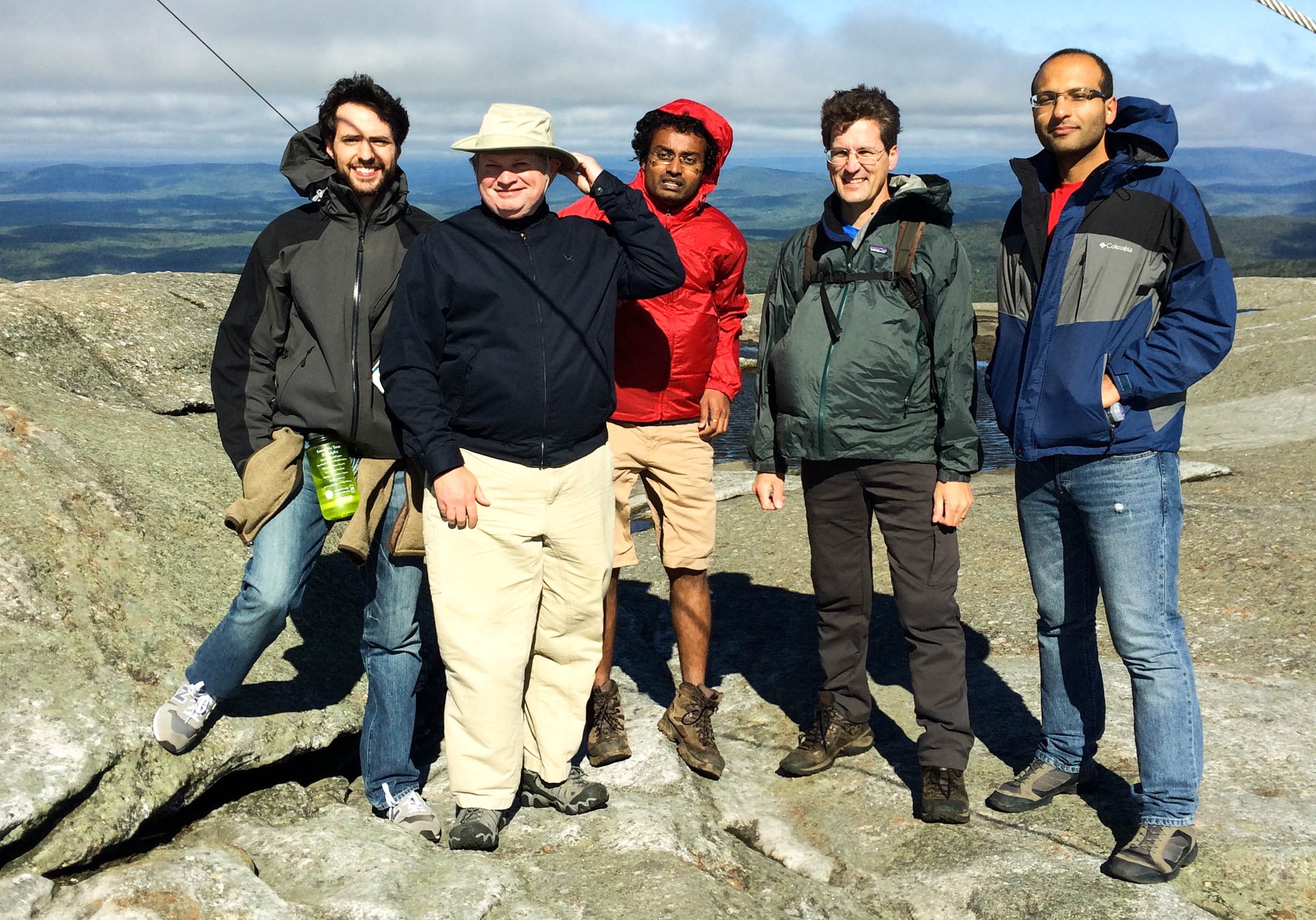
THaW hikers atop Mount Cardigan on a blustery NH day (AJ, Carl, Shrirang, David, Faraz).

THaW hikers atop Mount Cardigan on a blustery NH day (AJ, Carl, Shrirang, David, Faraz).

Jenna Wiens joins THaW team

Jenna Wiens is an Assistant Professor in EECS at the University of Michigan. In the fall of 2014, she joined the CSE division after completing her PhD at MIT.

Professor Wiens primary research interests lie at the intersection of machine learning and medicine. She especially enjoys solving the technical challenges that arise when considering the practical application of machine learning in clinical settings. Currently, she is focused on developing accurate patient risk stratification approaches that leverage data across time and space, with the ultimate goal of reducing the rate of healthcare-associated infections among patients admitted to hospitals in the US.