A new THaW paper in Health Sciences Research from Choi, Johnson, and Lehmann explores the relationship between breach remediation efforts and hospital care quality. They found that hospital time‐to‐electrocardiogram increased as much as 2.7 minutes, and 30‐day acute myocardial infarction mortality increased as much as 0.36 percentage points, during the 3‐year window following a breach. They conclude that breach remediation efforts were associated with deterioration in timeliness of care and patient outcomes. Thus, breached hospitals and HHS oversight should carefully evaluate remedial security initiatives to achieve better data security without negatively affecting patient outcomes.
Category Archives: publication
SNAP: Proximity Detection with Single-Antenna IoT Devices
THaW graduate Tim Pierson will present SNAP, a method for proximity detection with single-antenna IoT devices at MobiCom in October.
Abstract: Providing secure communications between wireless devices that encounter each other on an ad-hoc basis is a challenge that has not yet been fully addressed. In these cases, close physical proximity among devices that have never shared a secret key is sometimes used as a basis of trust; devices in close proximity are deemed trustworthy while more distant devices are viewed as potential adversaries. Because radio waves are invisible, however, a user may believe a wireless device is communicating with a nearby device when in fact the user’s device is communicating with a distant adversary. Researchers have previously proposed methods for multi-antenna devices to ascertain physical proximity with other devices, but devices with a single antenna, such as those commonly used in the Internet of Things, cannot take advantage of these techniques.
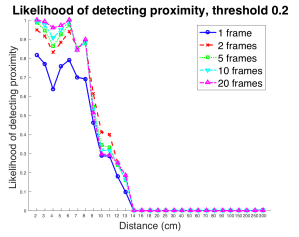
We present theoretical and practical evaluation of a method called SNAP — SiNgle Antenna Proximity — that allows a single-antenna Wi-Fi device to quickly determine proximity with another Wi-Fi device. Our proximity detection technique leverages the repeating nature Wi-Fi’s preamble and the behavior of a signal in a transmitting antenna’s near-field region to detect proximity with high probability; SNAP never falsely declares proximity at ranges longer than 14 cm.
In Proceedings of the ACM International Conference on Mobile Computing and Networking (MobiCom), Article #1-15, October 2019. ACM Press. DOI 10.1145/3300061.3300120.
CloseTalker: Secure, Short-range Communication
THaW researchers will present a paper titled CloseTalker: Secure, Short-range Ad Hoc Wireless Communication at MobiSys next week.
Abstract: Secure communication is difficult to arrange between devices that have not previously shared a secret. Previous solutions to the problem are susceptible to man-in-the-middle attacks, require additional hardware for out-of-band communication, or require an extensive public-key infrastructure. Furthermore, as the number of wireless devices explodes with the advent of the Internet of Things, it will be impractical to manually configure each device to communicate with its neighbors.
Our system, CloseTalker, allows simple, secure, ad hoc communication between devices in close physical proximity, while jamming the signal so it is unintelligible to any receivers more than a few centimeters away. CloseTalker does not require any specialized hardware or sensors in the devices, does not require complex algorithms or cryptography libraries, occurs only when intended by the user, and can transmit a short burst of data or an address and key that can be used to establish long-term or long-range communications at full bandwidth.
In this paper we present a theoretical and practical evaluation of CloseTalker, which exploits Wi-Fi MIMO antennas and the fundamental physics of radio to establish secure communication between devices that have never previously met. We demonstrate that CloseTalker is able to facilitate secure in-band communication between devices in close physical proximity (about 5 cm), even though they have never met nor shared a key.
Timothy J. Pierson, Travis Peters, Ronald Peterson, and David Kotz. Proceedings of the ACM International Conference on Mobile Systems, Applications, and Services (MobiSys), June 2019. ACM Press. DOI 10.1145/3307334.3326100.

Cybersecurity vulnerabilities
Tattle Tail Security
Lanier Watkins, Shreya Aggarwal, Omotola Akeredolu, William H. Robinson and Aviel D. Rubin recently published a paper titled Tattle Tail Security: An Intrusion Detection System for Medical Body Area Networks:
Abstract: Medical Body Area Networks (MBAN) are created when Wireless Sensor Nodes (WSN) are either embedded into the patient’s body or strapped onto it. MBANs are used to monitor the health of patients in real-time in their homes. Many cyber protection mechanisms exist for the infrastructure that interfaces with MBANs; however, not many effective cyber security mechanisms exist for MBANs. We introduce a low-overhead security mechanism for MBANs based on having nodes infer anomalous power dissipation in their neighbors to detect compromised nodes. Nodes will infer anomalous power dissipation in their neighbors by detecting a change in their packet send rate. After two consecutive violations, the node will “Tattle” on its neighbor to the gateway, which will alert the Telemedicine administrator and notify all other nodes to ignore the compromised node.
Workshop on Decentralized IoT Systems and Security (DISS ’19), (February, 2019). (pdf)
Intrusion Detection for Medical Body Area Networks (MBAN)
THaW researchers recently presented a new paper at the Workshop on Decentralized IoT Systems and Security (DISS). [PDF]
Abstract: Medical Body Area Networks (MBAN) are created when Wireless Sensor Nodes (WSN) are either embedded into the patient’s body or strapped onto it. MBANs are used to monitor the health of patients in real-time in their homes. Many cyber protection mechanisms exist for the infrastructure that interfaces with MBANs; however, not many effective cyber security mechanisms exist for MBANs. We introduce a low-overhead security mechanism for MBANs based on having nodes infer anomalous power dissipation in their neighbors to detect compromised nodes. Nodes will infer anomalous power dissipation in their neighbors by detecting a change in their packet send rate. After two consecutive violations, the node will “Tattle” on its neighbor to the gateway, which will alert the Telemedicine administrator and notify all other nodes to ignore the compromised node.

Proposed Telemedicine Scenario
IoT Two-Factor Neurometric Authentication
Angel Rodriguez, Sara Rampazzi, and Kevin Fu recently had a poster accepted titled IoT Two-Factor Neurometric Authentication System using Wearable EEG:
Abstract: The IoT authentication space suffers from various user-sided drawbacks, such as poor password choice, the accidental publication of biometric data, and the practice of disabling authentication completely. This is commonly attributed to the “Security vs Usability” problem – generally, the stronger the authentication, the more inconvenient it is to perform and maintain for the user. Neurometric authentication offers a compelling resistance to eavesdropping and replay attacks, and the ability for a user to simply “think to unlock”. Furthermore, the recent increase in popularity of consumer EEG devices, as well as new research demonstrating its accuracy, have made EEG-based neurometric authentication much more viable.
Using a Support Vector Machine and one-time tokens, we present a secure two-factor authentication method, that allows a user to authenticate multiple IoT devices. We perform preliminary trials on the Psyionet BCI dataset and demonstrate a qualitative comparison of extracted EEG feature sets.
Left: IoT two factor authentication scheme – (1) After internal user-thought authentication, the device securely sends a one-time token to the IoT device. (2) The IoT device securely communicates with a server to verify the token. (3) If the token is verified, the server sends a secure confirmation reply to the IoT device, authenticating the user. Right: Proof of concept using the Psyionet BCI dataset – The top row shows the averaged covariance matrices of the extracted features of two different users thinking about the same mental task (imagining closing their fists). The bottom row shows similar features for one user thinking of two different tasks (imagine closing both fists vs both feet).
Proceedings of the IEEE Workshop on the Internet of Safe Things (SafeThings), May 2019. Accepted, publication pending.
Proximity Detection
Timothy J. Pierson, Travis Peters, Ronald Peterson, and David Kotz recently published a paper titled Proximity Detection with Single-Antenna IoT Devices:
Abstract: Providing secure communications between wireless devices that encounter each other on an ad-hoc basis is a challenge that has not yet been fully addressed. In these cases, close physical proximity among devices that have never shared a secret key is sometimes used as a basis of trust; devices in close proximity are deemed trustworthy while more distant devices are viewed as potential adversaries. Because radio waves are invisible, however, a user may believe a wireless device is communicating with a nearby device when in fact the user’s device is communicating with a distant adversary. Researchers have previously proposed methods for multi-antenna devices to ascertain physical proximity with other devices, but devices with a single antenna, such as those commonly used in the Internet of Things, cannot take advantage of these techniques.
We present theoretical and practical evaluation of a method called SNAP – SiNgle Antenna Proximity – that allows a single-antenna Wi-Fi device to quickly determine proximity with another Wi-Fi device. Our proximity detection technique leverages the repeating nature Wi-Fi’s preamble and the behavior of a signal in a transmitting antenna’s near-field region to detect proximity with high probability; SNAP never falsely declares proximity at ranges longer than 14 cm.
Proceedings of the ACM International Conference on Mobile Computing and Networking (MobiCom), October 2019. ACM Press. Accepted for publication. DOI 10.1145/3300061.3300120.
De Facto Diagnosis Specialties: Recognition and Discovery
Aston Zhang, Xun Lu, Carl A. Gunter, Shuochao Yao, Fangbo Tao, Rongda Zhu, Huan Gui, Daniel Fabbri, David Liebovitz, and Bradley Malin recently published a paper titled De Facto Diagnosis Specialties: Recognition and Discovery:
A medical specialty indicates the skills needed by health care providers to conduct key procedures or make critical judgments. However, documentation about specialties may be lacking or inaccurately specified in a health care institution. Thus, we propose to leverage diagnosis histories to recognize medical specialties that exist in practice. Such specialties that are highly recognizable through diagnosis histories are de facto diagnosis specialties. We aim to recognize de facto diagnosis specialties that are listed in the Health Care Provider Taxonomy Code Set (HPTCS) and discover those that are unlisted. First, to recognize the former, we use similarity and supervised learning models. Next, to discover de facto diagnosis specialties unlisted in the HPTCS, we introduce a general discovery‐evaluation framework. In this framework, we use a semi‐supervised learning model and an unsupervised learning model, from which the discovered specialties are subsequently evaluated by the similarity and supervised learning models used in recognition. To illustrate the potential for these approaches, we collect 2 data sets of 1 year of diagnosis histories from a large academic medical center: One is a subset of the other except for additional information useful for network analysis. The results indicate that 12 core de facto diagnosis specialties listed in the HPTCS are highly recognizable. Additionally, the semi‐supervised learning model discovers a specialty for breast cancer on the smaller data set based on network analysis, while the unsupervised learning model confirms this discovery and suggests an additional specialty for Obesity on the larger data set. The potential correctness of these 2 specialties is reinforced by the evaluation results that they are highly recognizable by similarity and supervised learning models in comparison with 12 core de facto diagnosis specialties listed in the HPTCS.
Learning Health Systems, 2018:e10057, 2018. DOI: 10.1002/lrh2.10057
NRF: A Naive Re-identification Framework
Shubhra Kanti, Karmaker Santu, Vincent Bindschadler, ChengXiang Zhai, and Carl A. Gunter recently published a paper titled NRF: A Naive Re-identification Framework:
The promise of big data relies on the release and aggregation of data sets. When these data sets contain sensitive information about individuals, it has been scalable and convenient to protect the privacy of these individuals by de-identification. However, studies show that the combination of de-identified data sets with other data sets risks re-identification of some records. Some studies have shown how to measure this risk in specific contexts where certain types of public data sets (such as voter roles) are assumed to be available to attackers. To the extent that it can be accomplished, such analyses enable the threat of compromises to be balanced against the benefits of sharing data. For example, a study that might save lives by enabling medical research may be enabled in light of a sufficiently low probability of compromise from sharing de-identified data. In this paper, we introduce a general probabilistic re-identification framework that can be instantiated in specific contexts to estimate the probability of compromises based on explicit assumptions. We further propose a baseline of such assumptions that enable a first-cut estimate of risk for practical case studies. We refer to the framework with these assumptions as the Naive Re-identification Framework (NRF). As a case study, we show how we can apply NRF to analyze and quantify the risk of re-identification arising from releasing de-identified medical data in the context of publicly-available social media data. The results of this case study show that NRF can be used to obtain meaningful quantification of the re-identification risk, compare the risk of different social media, and assess risks of combinations of various demographic attributes and medical conditions that individuals may voluntarily disclose on social media.
ACM Workshop on Privacy in an Electronic Society (WPES ’18), Toronto, Canada, October 2018. DOI: 10.1145/3267323.3268948