THaW Paper on the Impact of Data Breaches

The healthcare field, abounding with lucrative patient data, attracts both internal and external adversaries. In this paper, we study the impact of data breaches on operational performance and identify how operational, technological, and market factors moderate the impact. We describe ex-post resilience strategies, look at institutional and operational approaches beyond security-specific factors, and shed light on critical nuances for IT strategies.

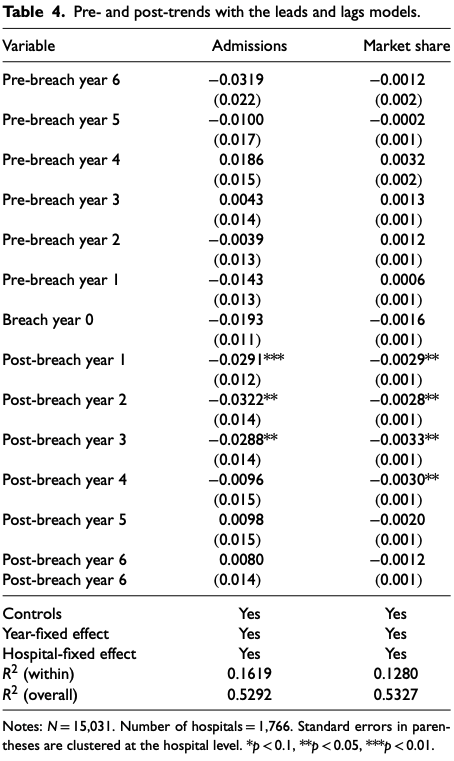
We find that while a breach negatively impacts hospital performance, its impact is most pronounced in the 3 years after a breach and diminishes in the subsequent years. From a technological perspective, our findings indicate that hospitals heavily reliant on cloud-based IT services experience more pronounced negative impacts.

To learn more about our findings and recommendations for hospital managers and policymakers, check out the paper!
Kwon, Juhee, and M Eric Johnson. “Unraveling the Impact of Data Breaches: Evidence From the US Healthcare Sector.” Production and Operations Management 34, no. 7 (2025): 1779–1798. Accessed October 15, 2025. https://journals.sagepub.com/doi/10.1177/10591478241305351.

New THaW Patent: Data System with Information Provenance

The THaW team is proud to announce the issuing of a patent for a secure, integrated data system and method that employs blockchain and Trusted Execution Environment (TEE) technologies. This method achieves information provenance for data, particularly, mobile health device data.

Using a blockchain to record and enforce data access policies removes the need to trust a single entity with gatekeeping the health data. Instead, participants form a consortium and collectively partake in verifying and enforcing access policies for data stored in private data silos. Data access and computation takes place inside of TEEs, which preserves data confidentiality and provides a verifiable attestation that can be stored on the blockchain for the purpose of information provenance.

This ensures that patients have confidence in the privacy of their original health data that may be managed by multiple entities, and provides security and information provenance for that data while it is aggregated or transformed during interactions between patient and healthcare professionals.

To learn more, check out the patent! Organizations interested in this patented work are encouraged to contact the authors.

Hardin, Taylor, and David Kotz. Data system with information provenance. US20210273812A1, issued September 2, 2021. https://patents.google.com/patent/US20210273812A1/en.

THaW Comes to a Close

Featured

In 2013, the National Science Foundation’s Secure and Trustworthy Cyberspace program awarded a Frontier grant to a consortium of four institutions — Dartmouth College, the University of Michigan, the University of Illinois Urbana-Champaign, and Johns Hopkins University — to enable trustworthy cybersystems for health and wellness. Over the years, THaW grew to include researchers from Vanderbilt University, Morgan State University, and George Washington University.

Over 80 students and postdocs engaged in THaW research activities over the span of the project, and the project’s bibliography includes more than 130 significant publications. You can find an organized overview of these publications here. The THaW team devised systems and methods to enhance security, resulting in 11 patents. Team members were featured in various news outlets, and THaW PI Kevin Fu co-founded VirtaLabs to identify, assess, patch, and track clinical assets in health care environments.

THaW collaborated with The Archimedes Center for Medical Device Security in Michigan to offer a twice-annual training conference on how to integrate THaW security principles into the design of medical devices to clinical engineers and CISOs from hospitals and medical device manufacturers. Over 10,000 people and more than 100 industry organizations attended the events. In addition, Archimedes conducted on-site security training for more than 500 medical device engineers over the years.

If you are interested in taking advantage of any of the resources within this site, the contact us page of this website will remain active. The rest of the website will no longer be updated. Thank you to those of you who have followed this site and the THaW project over the past 11 years.

The THaW group at its annual meeting in 2017 (top) and its first annual meeting in 2013 (bottom)

New THaW Patent: Secure Short-Range Wireless Communication

The THaW team is proud to announce the issuing of a patent for apparatuses, methods, and software for secure short-range wireless communication.

With the number and diversity of Internet of Things (IoT) devices growing, cryptography is not a blanket solution for secure message exchange. Devices may encounter dozens or hundreds of new devices each day, and many of these new IoT devices will have limited or non-existent user interfaces, making this manual secret entry even more cumbersome than configuring existing devices.

This work focuses on a secure method to wirelessly transmit data between devices that are in short-range of each other. In this setup, the sending device has two antennas and two transmitters. One transmitter sends a data signal via the first antenna, which is closer to the target device than the second antenna, and another transmits a jamming signal via the second antenna. Because of the close proximity between the target device and the first antenna, which results in a stronger signal, the receiving device can retrieve the data despite the presence of the jamming signal. This ensures a secure-communications process between the sending device and the target device.

To learn more, check out the patent. If you are interested in taking advantage of this patent, please contact us.

Timothy J. Pierson, Ronald Peterson, and David Kotz. Apparatuses, Methods, and Software for Secure Short-Range Wireless Communication. U.S. Patent 11,894,920 B2. February 06, 2024. Download from https://patents.google.com/patent/US11894920B2/en

See also: Timothy J. Pierson, Ronald Peterson, and David Kotz. Apparatuses, Methods, and Software For Secure Short-Range Wireless Communication. U.S. Patent 11,153,026, October 19, 2021. Download from https://patents.google.com/patent/US11153026B2/en

See also: Timothy J. Pierson, Travis Peters, Ronald Peterson, and David Kotz. CloseTalker: secure, short-range ad hoc wireless communication. Proceedings of the ACM International Conference on Mobile Systems, Applications, and Services (MobiSys), pages 340–352. ACM, June 2019. doi:10.1145/3307334.3326100. [Details]

New THaW Patent: Proximity Detection with Single-Antenna Device

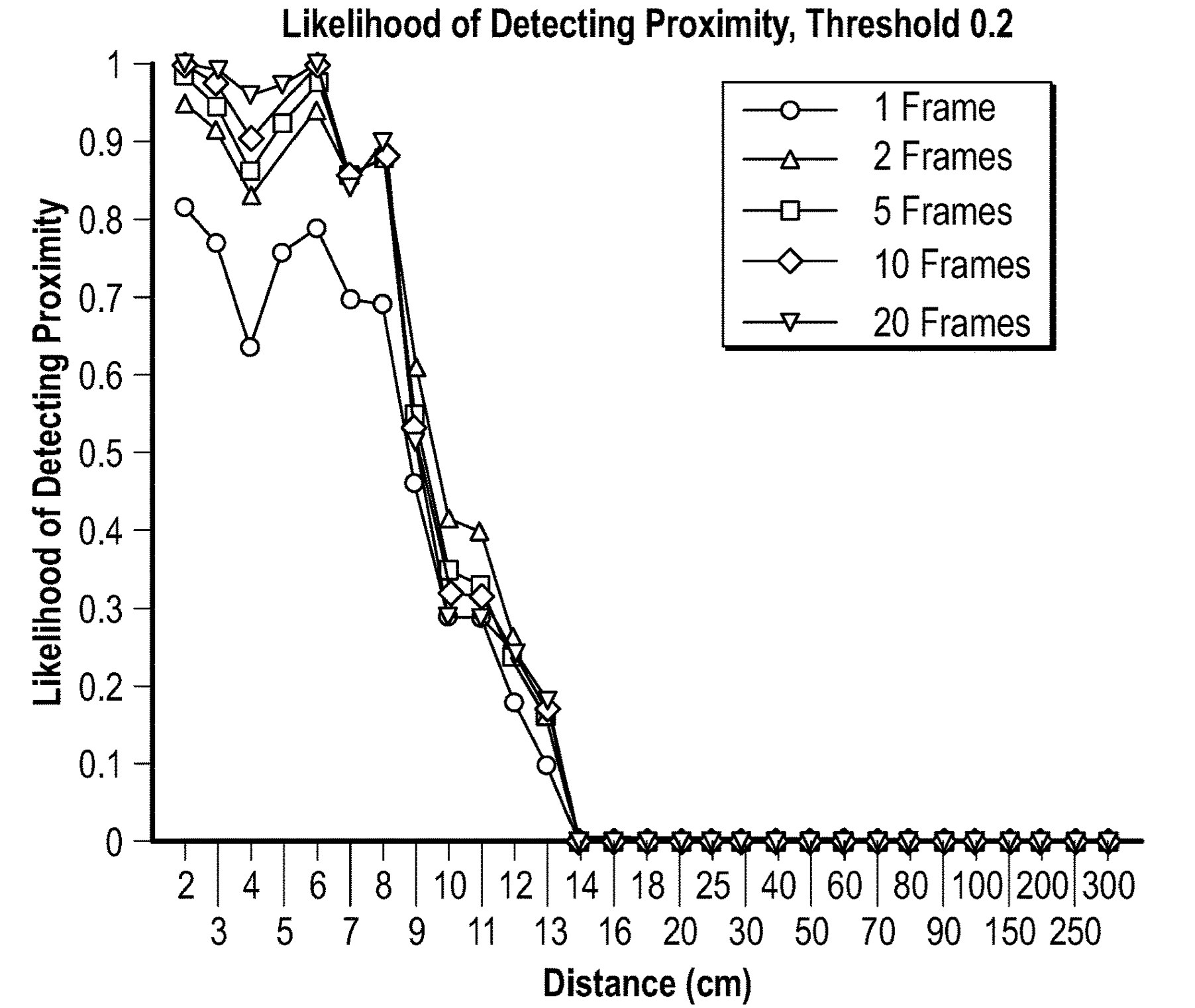
The THaW team is proud to announce the issuing of a patent for new methods for single-antenna devices to determine proximity between themselves and another device. Previous work in this field provides a method for secure short-range information exchange between a multi-antenna device and a target device. However, a single-antenna device cannot use a multi-antenna-based method and, therefore, has no way to verify its proximity to the target device.

In this patented work, a single-antenna devices uses the phase and/or amplitude of a preamble received from a transmitting device, particularly a repeating portion of the preamble, to determine whether the receiving device is in close proximity to the transmitting device. If the transmitting device is close to the single-antenna device, the repeating portions of the preamble will differ in phase and amplitude, while a large distance between the two will cause the repeating portions to have a substantially consistent phase and amplitude. This can be helpful in preventing a distant adversary from tricking the single-antenna-device into believing that a malformed preamble is a legitimate signal from a nearby device.

Interested in learning more? Check out the patent here!

PIERSON, Timothy J., Ronald Peterson, and David F. KOTZ. System and method for proximity detection with single-antenna device. US 11,871,233 B2, issued January 9, 2024. https://patents.google.com/patent/US11871233B2/en.

New THaW Patent: Pairing Wireless Devices

The THaW team is proud to announce the issuing of a patent for new methods to pair wireless devices resulting from the THaW project.

Current Internet of Things (IoT) device authentication protocols are functional, but not scalable, which is increasingly pertinent as more and more homes and health-focused establishments have multiple ‘smart’ devices. For example, a manufacturer of an Internet-connected blood oxygen monitor will not know the name or Wi-Fi password of an end-user’s wireless network and cannot program the device to immediately pair with the user’s access point (AP). As a result, end-users may have to set up the monitor on their own… along with dozens of other home devices. Traditional pairing protocols also rely on a one-way authentication scheme, which does not prevent the user from pairing a new device with a spoofed AP.

This recently patented pairing process involves two devices sending signals between each other and leverages the movement of objects near both of these devices, which similarly impacts both devices’ signal strength. The devices can confirm trust in each other if the signal-strength-pattern they receive substantially matches the signal-strength-pattern the other device receives.

Interested in learning more? Check out the patent here or below!

Pierson, Timothy J., and Jonathan F. Alter. Methods and software for pairing wireless devices using dynamic multipath signal matching, and wireless devices implementing the same. US11856408B2, issued December 26, 2023. https://patents.google.com/patent/US11856408B2/en.

Amanuensis: provenance, privacy, and permission in TEE-enabled blockchain data systems

Amanuensis, a TEE-enabled blockchain data-sharing system, allows data providers to set access-control lists for all data and ensures that data remains confidential in an ecosystem comprised of organizations that do not necessarily trust one another. Along with data confidentiality, Amanuensis provides information provenance – the ability to trace the origin of information that may have been derived from a series of aggregations and transformations on many input and intermediary data sets – for data created as the result of a computation. In this paper, we build on Amanuensis to ensure the freshness of access-control lists shared between the blockchain and the trusted execution environment (TEE), and to improve the privacy of users interacting within the system. We also detail how TEE-based remote attestation helps us to achieve information provenance – specifically, how to achieve information provenance in the context of the Intel SGX trusted execution environment. The paper makes three major contributions:

  • assured freshness of access-control lists stored on the blockchain,
  • expanded privacy for users interacting on blockchain, and
  • secured protocol for verifying the provenance of data produced by confidential TEE programs.

Taylor Hardin and David Kotz. Amanuensis: provenance, privacy, and permission in TEE-enabled blockchain data systems. Proceedings of the IEEE International Conference on Distributed Computing Systems, pages 144–156. IEEE, July 2022. doi:10.1109/ICDCS54860.2022.00023. ©Copyright IEEE.

New THaW Dissertation: ‘Information Provenance for Mobile Health Data’

We are proud to announce a THaW team members’ successful dissertation. Dr. Taylor Hardin’s dissertation focuses on an end-to-end solution for providing information provenance for mHealth data, which begins by securing mHealth data at its source: the mHealth device. 

The dissertation describes a memory-isolation method that combines compiler-inserted code and Memory Protection Unit (MPU) hardware to protect application code and data on ultra-low-power micro-controllers. The security of mHealth data outside of the source (e.g., data that has been uploaded to smartphone or remote-server) is then addressed with Amanuensis, a health-data system, which uses Blockchain and Trusted Execution Environment (TEE) technologies to provide confidential, yet verifiable, data storage and computation for mHealth data. The use of blockchain and TEEs introduce identity privacy and data freshness issues, which are explored. A privacy-preserving solution for blockchain transactions, and a freshness solution for data access-control lists retrieved from the blockchain are presented.

To learn more, check out Dr. Taylor Hardin’s dissertation below. 

Hardin, Taylor A., “Information Provenance for Mobile Health Data” (2022). Dartmouth College Ph.D Dissertations. 79. 
https://digitalcommons.dartmouth.edu/dissertations/79

VibeRing: An out-of-band channel for sharing secret keys

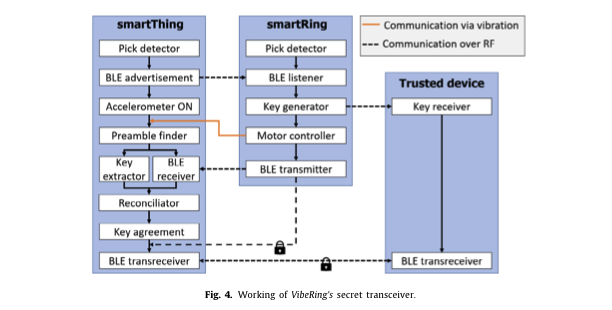
Health-oriented smart devices, such as a blood-glucose monitor, collect meaningful data when they are in use and in physical contact with their user. The smart device’s (“smartThing’s”) wireless connectivity allows it to transfer that data to its user’s trusted device, for example a smartphone. However, an adversary could impersonate the user and bootstrap a communication channel with the smartThing while the smartThing is being used by an oblivious legitimate user. 

To address this problem, in this paper, we investigate the use of vibration, generated by a smartRing, as an out-of-band communication channel to unobtrusively share a secret with a smartThing. This exchanged secret can be used to bootstrap a secure wireless channel over which the smartphone (or another trusted device) and the smartThing can communicate. We present the design, implementation, and evaluation of this system, which we call VibeRing. We describe the hardware and software details of the smartThing and smartRing. Through a user study we demonstrate that it is possible to share a secret with various objects quickly, accurately and securely as compared to several existing techniques.

Sougata Sen and David Kotz. VibeRing: Using vibrations from a smart ring as an out-of-band channel for sharing secret keys. Journal of Pervasive and Mobile Computing, volume 78, article 101505, 16 pages. Elsevier, December 2021. doi:10.1016/j.pmcj.2021.101505. ©Copyright Elsevier. Revision of sen:vibering.

New THaW Patent

The THaW team is pleased to announce one new patent derived from THaW research. For the complete list of patents, visit our Tech Transfer page.

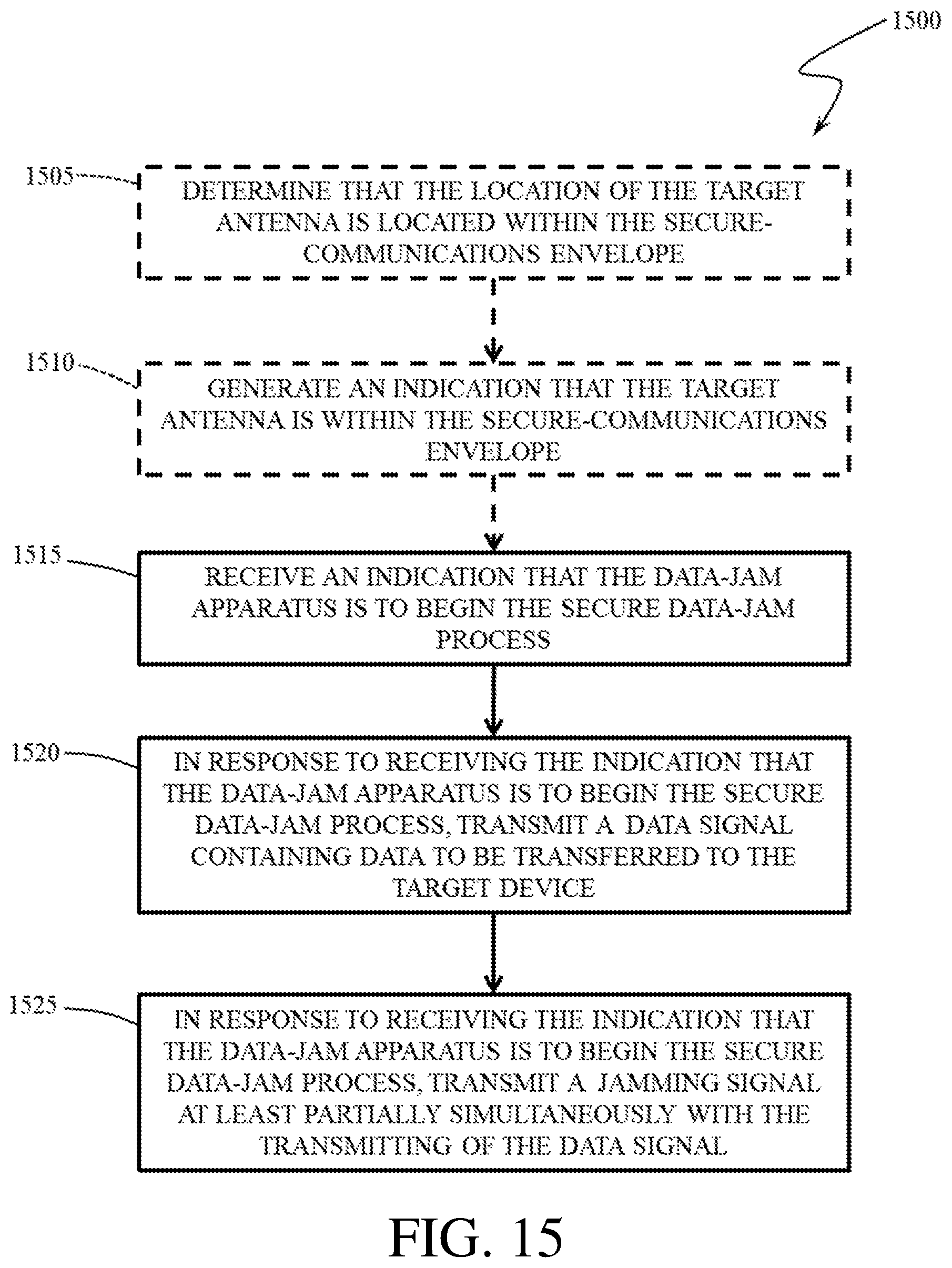
Abstract: Apparatuses that provide for secure wireless communications between wireless devices under cover of one or more jamming signals. Each such apparatus includes at least one data antenna and at least one jamming antenna. During secure-communications operations, the apparatus transmits a data signal containing desired data via the at least one data antenna while also at least partially simultaneously transmitting a jamming signal via the at least one jamming antenna. When a target antenna of a target device is in close proximity to the data antenna and is closer to the data antenna than to the jamming antenna, the target device can successfully receive the desired data contained in the data signal because the data signal is sufficiently stronger than the jamming signal within a finite secure-communications envelope due to the Inverse Square Law of signal propagation. Various related methods and machine-executable instructions are also disclosed.

Image describes the steps to ensure secure wireless data transfer between devices.

Timothy J. Pierson, Ronald Peterson, and David Kotz. Apparatuses, Methods, and Software For Secure Short-Range Wireless Communication. U.S. Patent 11,153,026, October 19, 2021. Download from https://patents.google.com/patent/US11153026B2/en

See also: Timothy J. Pierson, Travis Peters, Ronald Peterson, and David Kotz. CloseTalker: secure, short-range ad hoc wireless communication. Proceedings of the ACM International Conference on Mobile Systems, Applications, and Services (MobiSys), pages 340–352. ACM, June 2019. doi:10.1145/3307334.3326100. [Details]