THaW’s A.J. Burns and Eric Johnson recently published a piece in IT Professional:
Author Archives: David Kotz
Interview with Scott Breece – CISO, Community Health Systems
Scott Breece, VP and CISO of Community Health Systems, discusses the rising security threat in healthcare with M. Eric Johnson, Dean of Vanderbilt University’s Owen Graduate School of Management. Scott highlights how health IT is transforming healthcare, improving the patient experience and outcomes. However, digitization of healthcare data also creates new risks for the healthcare system. Scott discusses how Community Health Systems is staying ahead of those threats and securing patient data. This video was partially supported by the THaW project, which is co-led by Eric Johnson.
Best Poster – MobiCom’18
Tim Pierson’s dissertation work resulted in an innovative method for single-antenna Wi-Fi devices (like many mHealth devices, medical devices, or those in the IoT) to determine with strong confidence whether a Wi-Fi transmitter is close by (within a few centimeters). This proximity detector can be the basis for trustworthy relationships between devices. A poster paper about this idea just won the best-poster award at MobiCom 2018, and the full paper was just accepted for presentation at MobiCom 2019. See below for the abstract, or check out the corresponding three-page paper.
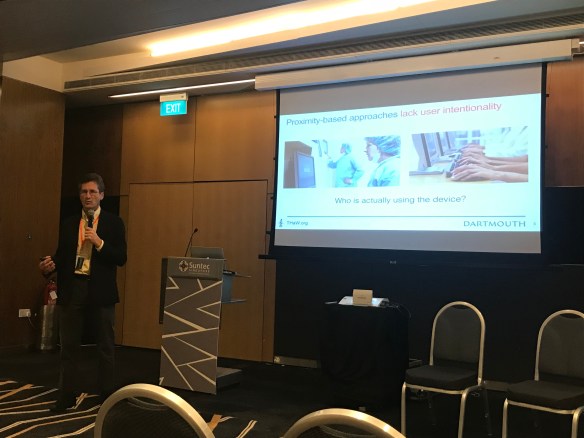
Ubicomp’18: securing clinical desktops with smart wristbands
Authentication has become an integral part of computer usage, but it still remains an interruptive step in people’s workflow. To authenticate to a computer, depending on the authentication method, users must exert mental effort (e.g., recall their password) and/or physical effort (e.g., type their password). These factors increase the cost of context switch for users – cost of switching attention from a primary task to the authentication step and back to the task – disrupting users’ workflow. Clinical staff have often told us they are frustrated by the need to repeatedly log into their clinical desktop computers – sometimes hundreds of times in a day.
In this paper, presented by David Kotz at Ubicomp’18 in Singapore, we propose Seamless Authentication using Wristbands (SAW). SAW is an authentication method designed to address this shortcoming of proximity-based authentication methods, and we do so by adding a quick low-effort user input step that explicitly captures user intentionality for authentication. In SAW, the user’s wristband (e.g., fitness tracker, smartwatch) acts as the user’s authentication token. Read more below, and in the paper.
Morgan State joins THaW
THaW welcomes Professor Kevin Kornegay and his students from Morgan State University in Baltimore MD. Kevin’s lab brings deep expertise in Medical IoT device security assessment, profiling, and hardening to an exploration of voice-based assistants.
Voice-assisted IoT devices such as Alexa, Siri, and Google Assistant are gaining use as portals for medical services. However, the potential safety and security issues they pose are not well understood by patients and consumers. In this collaboration, we will investigate some of the potential security issues of these devices using reverse engineering techniques to expose the vulnerabilities and propose recommendations for secure usage.
Ubicomp’18: vocal resonance as a biometric
At the Joint Conference on Pervasive and Ubiquitous Computing conference, Ubicomp, David Kotz presented THaW’s work to develop a novel biometric approach to identifying and verifying who is wearing a device – an important consideration for a medical device that may be collecting diagnostic information that is fed into an electronic health record. Their novel approach is to use vocal resonance, i.e., the sound of your voice as it passes through bones and tissues, for a device to recognize its wearer and verify that it is physically in contact with the wearer… not just nearby. They implemented the method on a wearable-class computing device and showed high accuracy and low energy consumption. 
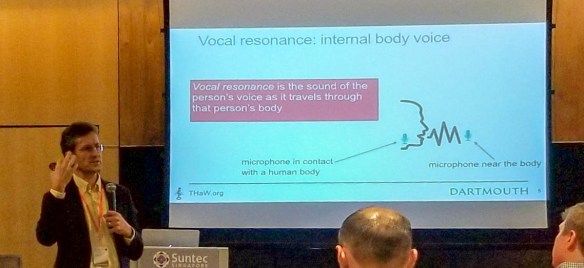
Rui Liu, Cory Cornelius, Reza Rawassizadeh, Ron Peterson, and David Kotz. Vocal Resonance: Using Internal Body Voice for Wearable Authentication. Proceedings of the ACM on Interactive, Mobile, Wearable and Ubiquitous Technologies (IMWUT) (UbiComp), 2(1), March 2018. DOI 10.1145/3191751.
Abstract: We observe the advent of body-area networks of pervasive wearable devices, whether for health monitoring, personal assistance, entertainment, or home automation. For many devices, it is critical to identify the wearer, allowing sensor data to be properly labeled or personalized behavior to be properly achieved. In this paper we propose the use of vocal resonance, that is, the sound of the person’s voice as it travels through the person’s body – a method we anticipate would be suitable for devices worn on the head, neck, or chest. In this regard, we go well beyond the simple challenge of speaker recognition: we want to know who is wearing the device. We explore two machine-learning approaches that analyze voice samples from a small throat-mounted microphone and allow the device to determine whether (a) the speaker is indeed the expected person, and (b) the microphone-enabled device is physically on the speaker’s body. We collected data from 29 subjects, demonstrate the feasibility of a prototype, and show that our DNN method achieved balanced accuracy 0.914 for identification and 0.961 for verification by using an LSTM-based deep-learning model, while our efficient GMM method achieved balanced accuracy 0.875 for identification and 0.942 for verification.
Broadening Participation @ NSF INCLUDES
Professor David Kotz attended the NSF INCLUDES Summit on Broadening Participation and presented a poster about THaW engagement and broadening participation activities. The workshop was a great opportunity to share ideas and to learn from the best practices of others.
THaW annual meeting
A large fraction of faculty, postdocs, staff and students gathered for the annual THaW meeting. This year the meeting was hosted by UIUC in glorious fall weather.

MobiSys poster
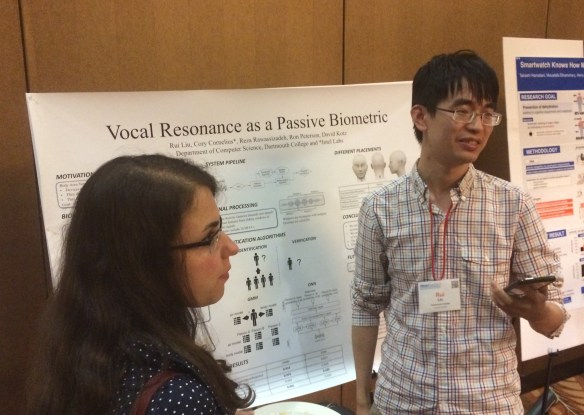
Congratulations to Rui Liu for being runner-up in the Best Poster competition at ACM MobiSys! Check out his poster on the use of vocal resonance as a passive biometric.

Rui Liu explains his work to attendees at ACM MobiSys’17.
WearSys papers, MobiSys posters
THaW researchers are showing off some cool research at this week’s MobiSys conference in Niagara Falls, with three papers at MobiSys workshops and a poster in the poster session.
- Aarathi Prasad and David Kotz. ENACT: Encounter-based Architecture for Contact Tracing. In ACM Workshop on Physical Analytics (WPA), pages 37-42, June 2017. ACM Press. DOI 10.1145/3092305.3092310.
- Rui Liu, Reza Rawassizadeh, and David Kotz. Toward Accurate and Efficient Feature Selection for Speaker Recognition on Wearables. InProceedings of the ACM Workshop on Wearable Systems and Applications (WearSys), pages 41-46, 2017. ACM Press. DOI 10.1145/3089351.3089352.
- Rui Liu, Cory Cornelius, Reza Rawassizadeh, Ron Peterson, and David Kotz. Poster: Vocal Resonance as a Passive Biometric. In Proceedings of the ACM International Conference on Mobile Systems, Applications, and Services (MobiSys), pages 160, 2017. ACM Press. DOI 10.1145/3081333.3089304.
- Xiaohui Liang and David Kotz. AuthoRing: Wearable User-presence Authentication. In Proceedings of the ACM Workshop on Wearable Systems and Applications (WearSys), pages 5-10, 2017. ACM Press. DOI 10.1145/3089351.3089357.